How to Start Thinking in a Foreign Language (And Why It Matters)
The Language Research Desk
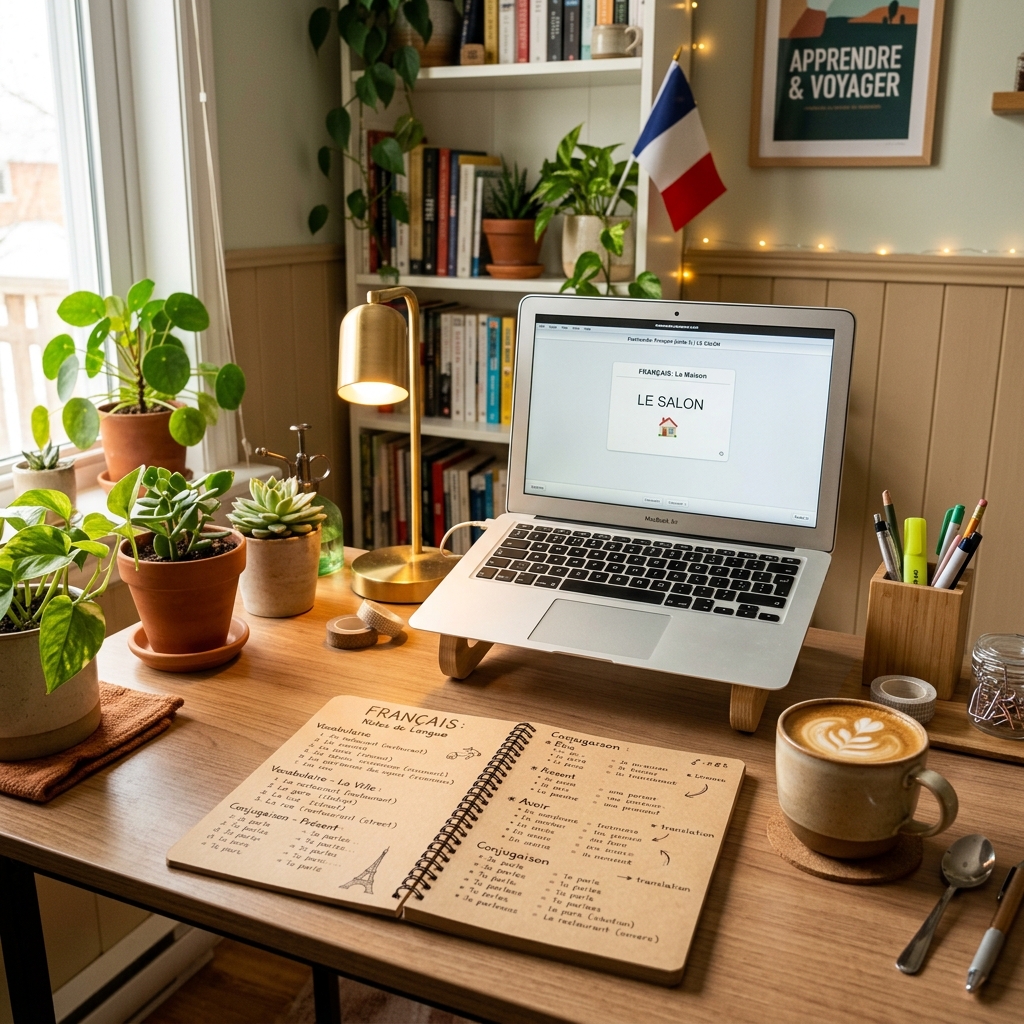
The Language Research Desk treats “thinking in a language” as a processing change, not a personality trait and not a travel-diary milestone. Learners who still translate every sentence can read and even pass tests. They stall in conversation because the English middleman is too slow. This page is a desk listing of what that bottleneck looks like, which methods shrink it, and how the shift differs from a language-learning plateau or from attrition when you have no one to speak with.
The desk did not sit in a classroom and time this on a stopwatch. The notes below come from how intermediate competence is usually described (CEFR B1–B2), from published memory and input research summarized on this site, and from methods that show up repeatedly in learner reports.
The Translation Bottleneck
Beginning and early-intermediate learners typically run a five-step loop:
- Hear or read input in the target language
- Translate it into English
- Decide what to say in English
- Translate that response back
- Speak or write
That loop is accurate enough to survive a textbook exercise. It is too slow for real speech. By the time step 5 arrives, the other person has already moved on. It also caps natural wording: you produce English thoughts wearing target-language clothes, which is why intermediate speech can sound like a glossary.
Two desk notes on this loop:
- Recognition is not the same as thinking. Understanding a sentence after a pause is still translation. Thinking in the language is when the pause is gone for that sentence type.
- You do not ban English on day one. New grammar and rare words still need an English gloss. The problem is routing high-frequency language through English forever.
Home immersion reduces how often English is available as an escape hatch. This page is about the mental habit that immersion is supposed to produce.
What Thinking in a Language Feels Like
When the shift starts, you skip steps 2 and 3 for some material. The German word Hund does not need to become the English word “dog” before a dog-image appears. The word and the thing sit together. English is still there for hard sentences. It is no longer required for the easy ones.
Learners usually notice it first in one of three places:
- Comprehension: a stretch of audio or a paragraph lands without a whispered English paraphrase.
- Routine talk: “Where are my keys?” or “I need coffee” appears in the target language first.
- Inner narration: the running commentary of a walk or a chore is no longer fully English.
It is not a full inner monologue from day one. Desk notes treat it as coverage: more and more of daily thought stops paying the English toll. That is also why vocabulary size matters. If you do not yet have the word families needed for everyday coverage, there is nothing to think with. You will keep falling back to English because the target language does not have the brick.
Desk Methods That Shrink the English Middleman
These are research-desk methods, not a claim that the desk lived in Madrid for eight weeks and tested them as a classroom. Use them as a checklist. They work because they force a direct link between a situation and target-language words.
1. Daily narration (high-frequency thought first)
Narrate what is already happening. Breakfast, the walk to work, packing a bag, opening a laptop. Keep the sentences short and present-tense at first. The point is not beautiful prose. The point is to stop waiting for an English sentence to exist before a target-language sentence is allowed.
Desk setup:
- Pick one recurring block (morning routine, commute, cooking) so the same verbs come back every day.
- When a word is missing, note it and keep moving. Do not freeze the whole narration to hunt one noun.
- After a week, the same block should need fewer English patches.
This is the cheapest overlap with immersion at home: the environment stays ordinary, the language of the commentary changes.
2. Monolingual lookup (definitions inside the language)
Bilingual dictionaries are the right tool for the first few hundred words. After that, an English gloss keeps rebuilding the middleman. A monolingual dictionary (or a learner dictionary written in the target language) forces a new loop: unknown word → known words → meaning. That is the same loop native speakers use.
Desk rules:
- Look up a word in English only if you cannot parse the monolingual definition at all.
- Prefer learner dictionaries (simple defining vocabulary) over native encyclopedias at B1.
- Write the definition, not the English equivalent, next to the word if you keep a notebook.
3. Image association (word to picture, not word to translation)
When a card or a note says casa = house, you have trained a translation. When casa sits next to a picture of a specific building, a door, or a memory of a room, you have trained a concept. Flashcard apps that allow images exist for this reason; the desk comparison of those apps is in best flashcard apps for vocabulary. The spaced-repetition science page covers why those cards need a review schedule, not only a pretty picture.
Desk rules:
- One image, one sense of the word. Do not put five meanings on one card.
- Prefer a personal or concrete picture over a stock icon when you can.
- Add a short example sentence once the bare word is stable.
4. Self-talk (output without a partner)
Talking to yourself is production. You still retrieve words, assemble grammar, and move your mouth. What you do not get is someone else’s questions or corrections. That is enough for thinking practice. It is not enough, by itself, for social fluency.
Desk setup:
- Ask and answer one question out loud: what you will do next, what you just read, whether you agree with a headline.
- Two to five minutes is enough if it happens most days.
- Record a 60-second monologue once a week if you want to hear whether the English pause is shrinking.
If the problem is that there is literally no partner, pair this with the solo maintenance routines. Self-talk keeps the thinking habit alive. It does not replace a tutor when you want feedback.
5. Dreaming is a report, not a method
The desk cannot assign “dream in the language” as homework. Learners often report dreams after a stretch of heavy input. Treat that as a commonly mentioned indicator that the language has reached automatic memory, not as proof of fluency and not as something this desk has timed in a sleep lab. If you never dream in the language and you already think through daily tasks in it, you are not failing a test.
When the Shift Typically Starts (B1–B2)
CEFR B1 is independent, everyday language. B2 is fluent conversation across a wider range of topics. Desk notes put the start of thinking-without-translating in that window for most English-speaking learners of Category I languages. It does not land as a single day.
Typical order:
- Formulaic chunks — greetings, ordering, “I think that…”
- Concrete narration — what you are doing, what you see
- Opinions and plans — still patchy, still some English
- Abstract or technical thought — last, and only if the vocabulary exists
Two caveats the desk will not paper over:
- A Category IV language with a new writing system usually delays this, because decoding itself stays effortful longer. See how long it takes to learn a language for FSI hour bands. The thinking shift still tracks usable coverage, not calendar months.
- App-only beginners can recognize hundreds of words and still translate every sentence. Recognition decks without output keep the English loop intact.
The more comprehensible input you take in, and the more you produce even badly, the more of the language can run without a translation step. That is a coverage and habit problem, not a motivation slogan.
Plateau, Attrition, and the Thinking Shift Are Different Diagnoses
These three get mixed together because they all feel like “I am not getting better.” They are not the same file.
| What you notice | Desk diagnosis | What it is not |
|---|---|---|
| You study, you can communicate, but progress feels invisible | Intermediate plateau | Failure, or proof you should quit |
| You stopped using the language and speaking got rusty | Attrition / no-partner maintenance | A thinking-shift problem |
| Easy sentences no longer need English in the middle | Thinking in the language (this page) | Full fluency, or a dream requirement |
A plateau can include the thinking shift. Intermediate learners are often mid-reorganization: enough language to notice errors, not enough automaticity to avoid them. That discomfort is awareness, not proof the method died. The diagnosis lives on the plateau page. The weekly method-change checklist lives on the tactics sibling. Do not 301 one onto the other; they answer different questions.
If input is the missing piece, compare approaches on language learning methods and rebuild a home environment with immersion at home. If the missing piece is words that stay, use spaced repetition and a sane flashcard app instead of rereading a bilingual word list.
What the Desk Would Check This Week
A short listing, not a scored program:
- Are you still translating high-frequency phrases you have seen a hundred times? Those are the first candidates for narration and image cards.
- Is your dictionary still English-only for words you could define with words you already know?
- Are you producing anything daily, even two minutes of self-talk?
- If progress feels flat while you are still studying, read the plateau diagnosis before you restart a beginner app.
- If you already reached a usable level and then stopped, that is maintenance, not a new “how to think” project.
Thinking in a language is the point at which the language starts to be a tool instead of a puzzle. It starts late-beginner to mid-intermediate, on common words, and it spreads. The English middleman does not vanish. It gets used less.
Frequently Asked Questions
When do people start thinking in a new language? ▼
The Language Research Desk's reading of learner reports and CEFR descriptions puts the start around B1 to B2. It begins with high-frequency phrases (greetings, routine tasks, simple opinions) and spreads to longer thought. It is gradual, not a single overnight switch.
Is thinking in a language the same as a plateau? ▼
No. A plateau is still studying while visible progress goes quiet. Thinking without an English middleman is a processing change that often starts during that same intermediate window. They can overlap, but they are not the same diagnosis.
How is thinking in a language different from attrition? ▼
Attrition is what happens after you stop using a language: retrieval slows and rare words fade. Thinking in the language is a sign the system is becoming usable. If skills are slipping because you have no one to talk to, that is a maintenance problem, not a thinking-shift problem.
Do you have to stop translating completely? ▼
No. Desk notes treat translation as a tool that should shrink, not a habit you ban on day one. Beginners need the English bridge for new grammar. The goal is to stop routing every sentence through English once the words already have their own images and contexts.
Does talking to yourself actually help? ▼
Self-talk is production practice you can do without a partner. You still have to retrieve words and assemble grammar. It does not replace unpredictable conversation, but it is one of the few daily methods that trains thinking in the language instead of only recognizing it.
We research and compile information about language learning from linguistic studies, FSI data, and language learning communities.
Related reading
Learning TipsCognates and False Friends: Your Shortcut (and Pitfall) in Language Learning
Cognates are free vocabulary. False friends are embarrassing traps. Here is how to tell the difference.
Learning TipsHow Many Words Do You Need to Be Fluent in a Language?
The real vocabulary numbers for fluency, from survival basics to native-level comprehension. Data-backed word count targets.
Learning TipsHow to Maintain a Second Language When You Have No One to Speak With
Keep a second language alive with no conversation partner. Solo speaking, reading, and listening routines that prevent attrition.